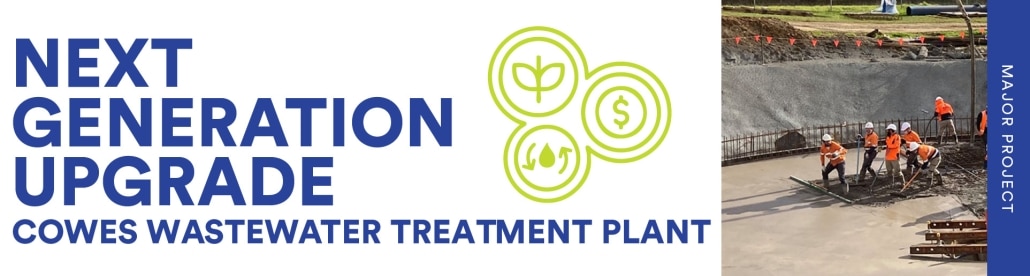
We’re embarking on a major upgrade to the Cowes Wastewater Treatment Plant to support economic prosperity and liveability on the Bass Coast.
The $27M* project will be our largest ever single infrastructure project and will ensure the plant has sufficient capacity for a projected increase in sewage volumes, while continuing to protect public health and the environment.
*2025 estimate subject to market conditions.
Watch our Virtual Information Session
Frequently Asked Questions
For answers to commonly asked questions, click here.
The case for change
The existing treatment plant
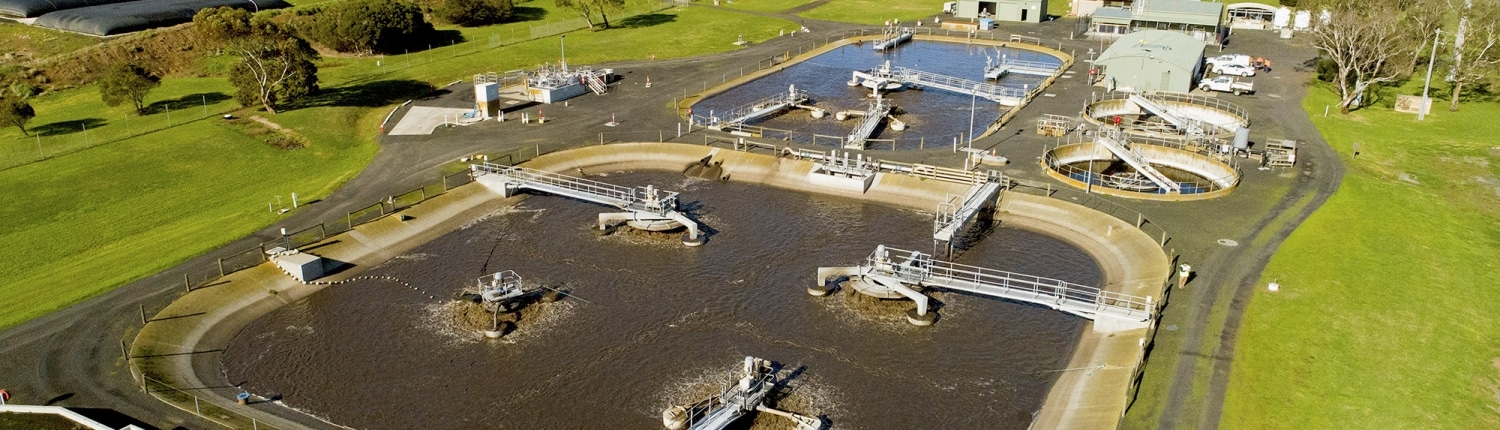
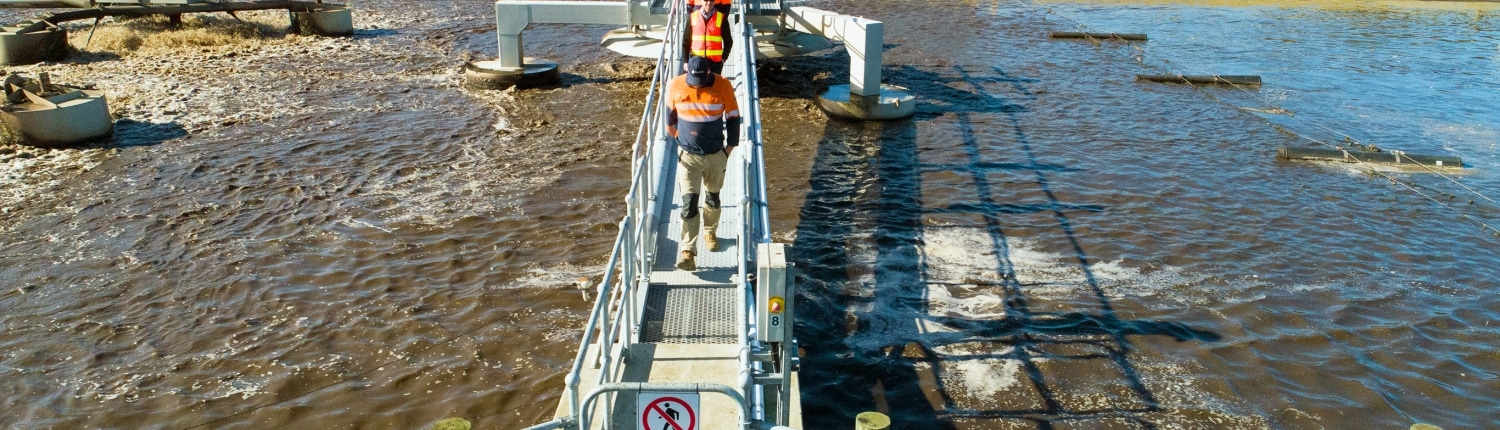
Commissioned in 1982, the Cowes Wastewater Treatment Plant (WWTP) is Westernport Water’s (WPW) primary treatment facility, servicing Phillip Island and the township of San Remo.
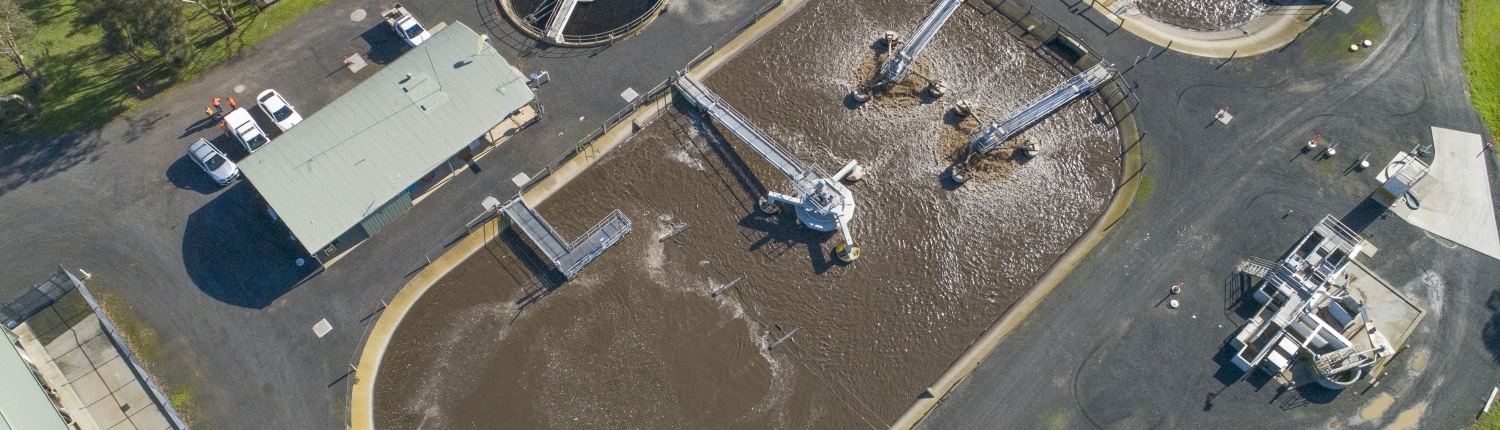
Commissioned in 1982, the treatment plant was originally designed to treat up to 3.4 megalitres per day to serve an equivalent population of around 14,000 customers. Its original configuration featured extended aeration activated sludge lagoons with secondary clarification and effluent disinfection.
Since then, the facility has undergone multiple upgrades to keep pace with significant population growth and to ensure compliance with evolving Environment Protection Authority (EPA) Victoria regulations.
Today, Cowes WWTP services approximately 13,700 properties and treats around 80% of WPW’s total wastewater flows. The remaining 20% is treated at a second treatment plant in Corinella. The Cowes WWTP primarily produces Class C treated effluent, which is discharged to Bass Strait under an EPA operating licence, while also generating Class A and Class B recycled water.
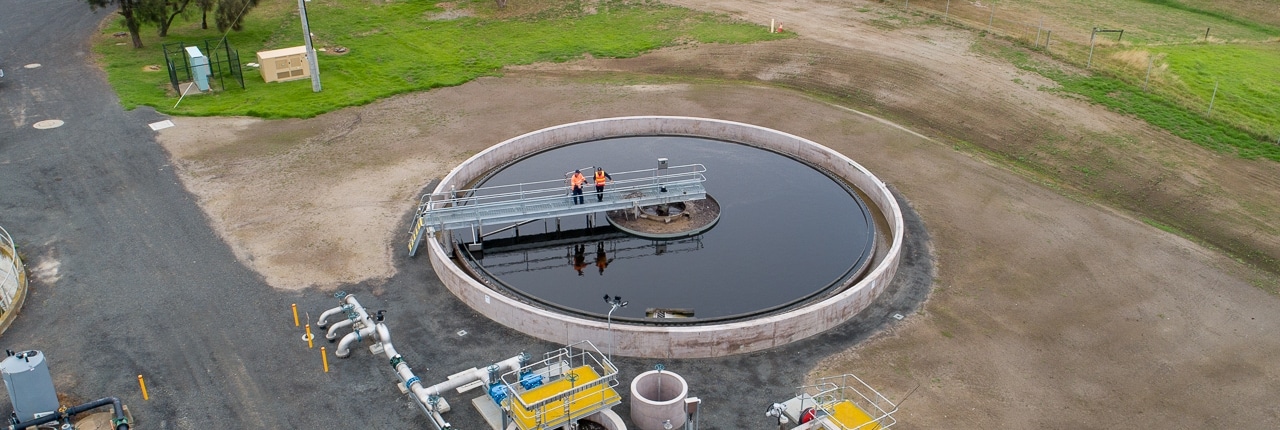
Class B water supports local irrigation, and Class A water is distributed through WPW’s recycled water network, aligning with the organisation’s Recycled Water Strategy and EPA guidelines.
Responsive to the needs of housing, economic growth, peak demand and wet weather events
In 2023, a 25-year master plan was developed for the Cowes Wastewater Treatment Plant (WWTP) using historical growth assessments and the latest census data to inform long-term planning for the facility.
The study projected an average annual growth rate of 1.62% across the catchment.
While this growth rate appears moderate, its cumulative effect over time will significantly increase wastewater volumes and nutrient loads entering the Cowes WWTP, placing growing pressure on treatment capacity and environmental performance.
The master plan also identified that by 2028, WPW’s ability to consistently meet treated effluent discharge compliance requirements at Cowes WWTP is expected to decline.
This risk is particularly pronounced during wetter-than-average years, when inflows increase substantially and can push the plant closer to its licensed discharge capacity. As these peak daily inflows approach existing licence limits, WPW will need to negotiate amendments to its operating licence with the Environment Protection Authority (EPA).
Early discussions with EPA indicate that any approval for increased discharge capacity would likely be contingent on achieving lower nutrient concentrations in treated effluent, reinforcing the need for process optimisation and infrastructure investment.
Peak seasonal events further compound these challenges. Annual periods of intense visitation such as the Christmas to New Year holidays, the Phillip Island MotoGP, and other long weekends, bring a rapid influx of people to the island. This results in a sudden rise in both the volume and concentration of influent wastewater received at Cowes WWTP.
Elevated nutrient concentrations, particularly during warmer weather, can disrupt the biological treatment process by “shocking” the microorganisms responsible for nutrient removal. This can temporarily reduce treatment efficiency and increase the risk of licence non-compliance during high-load periods. The upgrade would smooth or buffer the flow into the treatment process, reducing the impact of the shock nutrient loading.
Limiting customer bill impacts through improved management of wastewater treatment byproducts
The way wastewater by-products are currently managed at the Cowes Wastewater Treatment Plant (WWTP) is becoming increasingly difficult and inefficient.
The existing digester, the part of the plant that breaks down sludge, is too small and not the right shape to properly stabilise the waste. Because of this, the liquid waste (called supernatant) that is recycled back into the main treatment process varies a lot in nutrient levels.
These fluctuations make it harder for the plant to consistently treat wastewater to the right standard and can reduce the overall efficiency of the treatment process.
Each year, the Cowes WWTP produces about 14,000 cubic metres of wet sludge, which is dewatered using geobags and drying beds before being stockpiled in lined basins.
To manage space, the dried material (biosolids) has been applied to land in line with national environmental guidelines. However, stricter limits on certain contaminants such as PFAS, along with limited available land at the site, are making it much harder for Westernport Water (WPW) to continue this approach.
With the region’s population and wastewater volumes expected to grow, the amount of sludge produced will also increase. The Cowes WWTP master plan predicts that by 2048, the site will need around 20 geobags each year—double the current requirement. Given the site’s limited space, this is not a sustainable long-term solution.
Building a new sludge dewatering facility provides a more efficient and reliable way to manage these by-products. Reducing space constraints, cutting down on manual handling, and improving the overall sustainability of the treatment process.
Limiting future impacts of climate change by reducing greenhouse gas emissions
Westernport Water (WPW) has made a strong commitment to reducing its environmental footprint, aligning with the Victorian Government’s Statement of Obligations – Emissions Reduction (SoO-ER). Under this framework, WPW aims to achieve a 90% reduction in greenhouse gas emissions by 2030 and reach net zero emissions by 2035.
The Cowes Wastewater Treatment Plant (WWTP) plays a critical role in meeting these targets, as it is the corporation’s largest emissions source, responsible for approximately 55% of WPW’s total emissions since 2018, encompassing both scope 1 and scope 2 emissions.
Detailed assessments of Cowes WWTP have identified the anaerobic digester as the primary source of scope 1 emissions, contributing roughly 55% of the site’s total direct emissions. In response, WPW will be decommissioning and converting the anaerobic digester to an additional effluent storage tank.
Conversion of biogas waste to energy was assessed as way of managing biosolids in a more sustainable manner. The assessment concluded that diffused aeration would improve process resilience and nutrient removal, whilst achieving a reduction in scope 2 emissions.
Biogas cogeneration, however, was deemed unfeasible due to the lack of significant viable waste streams to generate a feedstock of significant strength to produce economic volumes of biogas.
As advances in waste management technology evolve, WPW will explore the feasibility of adopting such technologies.
Future improvements - increase in Class A and Class B recycled water reuse
In parallel with this project, we are undertaking stakeholder engagement and promotional work to explore options to increase the reuse of Class A and Class B recycled water. This will be achieved through targeted engagement in accordance with our Recycled Water Strategy.
Information collected will be used by WPW to inform future funding applications and subsequent investment to extend the recycled water network and associated infrastructure at Cowes WWTP.
Options may include one or a combination of the following:
- Increasing reuse volumes – additional Class A and B recycled water provided to existing commercial customers.
- More connections – increasing customer connections for large water users within the vicinity of the network that need a consistent annual volume of recycled water, even in wet years.
- Expanding the supply network- collaborating with neighbouring businesses, landholders, and government partners to reduce connection costs and enable greater uptake of recycled water.
- Additional benefits – suppling recycled water to customers whose use of recycled water provides broader community or environmental benefits, such as reducing potable water consumption during droughts, supporting agriculture or enabling industry growth.
Contact us
Please call 1300 720 711 or and ask to speak with Project Manager, Harsha Puvvala or email Westernport Water, cowesupgrade@westernportwater.com.au
National Relay Service (TTY Text Phone): 133 677 then ask for 5956 4100
If you are deaf, or have a hearing or speech impairment, contact us through the National Relay Service:
Page update 23 December 2025.