
Our customers can be reassured that their drinking water is safe and compliant with the Australian Drinking Water Guidelines and current national best practice guidance.
Screening completed at the Candowie Reservoir and Bass River offtakes in 2024 and 2025 did not detect PFAS chemicals. We undertake annual testing of our raw water supplies for specific PFAS chemicals: PFOS, PFHxS, and PFOA.
The Australian Drinking Water Guidelines specify limits for each of these chemicals.
Our testing results, conducted by an independent NATA-accredited laboratory, have shown that all three (3) PFAS chemicals are below the lowest detection limit and therefore below the limits stipulated in the national guidelines.
You can download recent and historical PFAS drinking water test results here.
What are PFAS
Per- and polyfluoroalkyl substances (PFAS) are human-made (also known as synthetic) chemicals that make products resistant to heat, stains, grease, and water.
PFAS (per-and polyfluoroalkyl substances, a group of chemicals) is widespread in the environment and is commonly found in non-stick cookware, water-resistant clothing, cleaning products and some personal care products. Westernport Water does not use PFAS substances in our water treatment or recycled water processes, and never has.
PFAS chemicals are a concern because they do not break down in the environment, they can move through soils and water, and they may bioaccumulate in plants and animals.
We began routine testing for PFAS chemicals in our raw drinking water supplies in 2024. This was a precautionary measure as our drinking water catchment has no known industrial activity or use of fire-fighting foam.
Is my drinking water safe?
Yes, our testing has proven that the drinking water we provide is safe and compliant with the Australian Drinking Water Guidelines and current national best practice guidance.
The National Health and Medical Research Council Australian Drinking Water Guidelines provide health-based guideline values for three PFAS substances*. These guideline values are designed to be protective over a lifetime. Our testing results show that PFAS concentrations in our raw water supplies are below the lowest detection limit and, therefore, are well below the drinking water guidelines.
You can also find out more about PFAS on the Australian Government’s PFAS website.
*Perfluorooctane sulfonate (PFOS), perfluorohexane sulphonate (PFHxS), and perfluorooctanoic acid (PFOA).
Government Action
The Water Services Association of Australia (WSAA) states that source control is the most effective means of preventing PFAS entering drinking water. That is, preventing the manufacture, use and import of products containing PFAS.
On 1st July 2025, the Australian Federal Government banned the use, manufacture and import of three specific PFAS chemicals (PFOA, PFOS and PFHxS) to protect people and the environment.
Further details and helpful information on PFAS are available:
Australian Drinking Water Guidelines and current national best practice guidance.
Water Services Association of Australia website
The Water Services Association of Australia – PFAS Resources
Frequently Asked Questions about PFAS
What prompted independent testing?
Westernport Water utilises a risk-based approach when assessing the risk of emerging contaminants within drinking water.
A risk assessment found Candowie Reservoir and its contributing waterways to be low risk as there is no history of bush fires in the catchment, industrial activity or fire-fighting activities; therefore, levels in the local environment are low.
In light of more recent research and community concern, Westernport Water undertook an independent testing program for the suite of PFAS compounds and their precursors in May 2024. Results showed levels to be below detectable levels and confirmed compliance with the Australian Drinking Water Guidelines.
Is commissioning of testing annual/regular/random?
Westernport Water apply a preventative risk-based approach to the management of drinking water quality. We routinely conduct a range of tests to ensure drinking water quality complies with the Australian Drinking Water Guidelines.
The low-range testing that was completed showed below-detectable levels of PFAS in Candowie Reservoir. Ongoing testing will continue as part of our annual program to ensure Westernport Water provides safe drinking water to our customers.
Westernport Water’s testing program will be reviewed if there are changes to the drinking water regulations.
What else do you test for and what are the results?
The Victoria Department of Health requires Westernport Water to undertake routine testing of source and supplied (treated) water throughout the distribution network. Our water quality testing parameters and results are published in Westernport Water’s Annual Drinking Water Quality Report: Water Quality – Westernport Water
Do you publish results?
Yes, our annual drinking water quality reports are available on our Water Quality webpage.
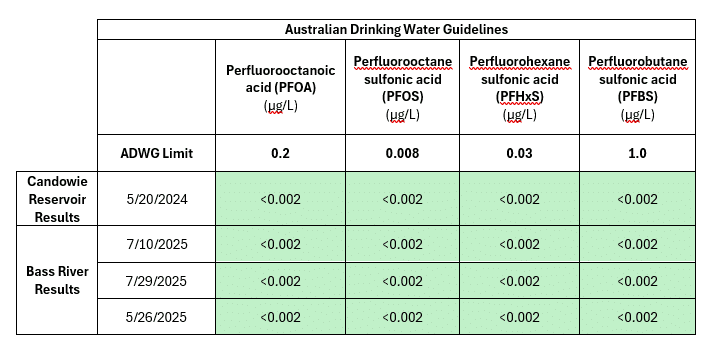
Sample results are shown against guideline values for drinking water sources.
Testing conducted did not detect PFAS chemicals.
Results reported as below 0.002 is the lowest detection limit of the tests performed by an independent NATA-accredited laboratory.
When test results show that no PFAS was detected, it is displayed as being below 0.002.
Table below: Sample results (green) shown against guideline values (bold) for drinking water sources.
<0.002[/av_cell][av_cell col_style='' av_uid='av-510qrnh']<0.002[/av_cell][av_cell col_style='' av_uid='av-4b2hd6l']<0.002[/av_cell][av_cell col_style='' av_uid='av-3shvku5']<0.002[/av_cell][/av_row] [av_row row_style='' av_uid='av-3apjvq5'][av_cell col_style='avia-desc-col' av_uid='av-2ubw671']Bass River[/av_cell][av_cell col_style='' av_uid='av-2hxjhz1']07/10/2025[/av_cell][av_cell col_style='' av_uid='av-1xvj4nx']<0.002[/av_cell][av_cell col_style='' av_uid='av-1s4p53x']<0.002[/av_cell][av_cell col_style='' av_uid='av-11v2czh']<0.002[/av_cell][av_cell col_style='' av_uid='av-m3m4bh']<0.002[/av_cell][/av_row] [/av_table]